
Iryna’s Law in North Carolina: How the New Bail Rules Affect Defendants, Families, and Bail Bondsmen
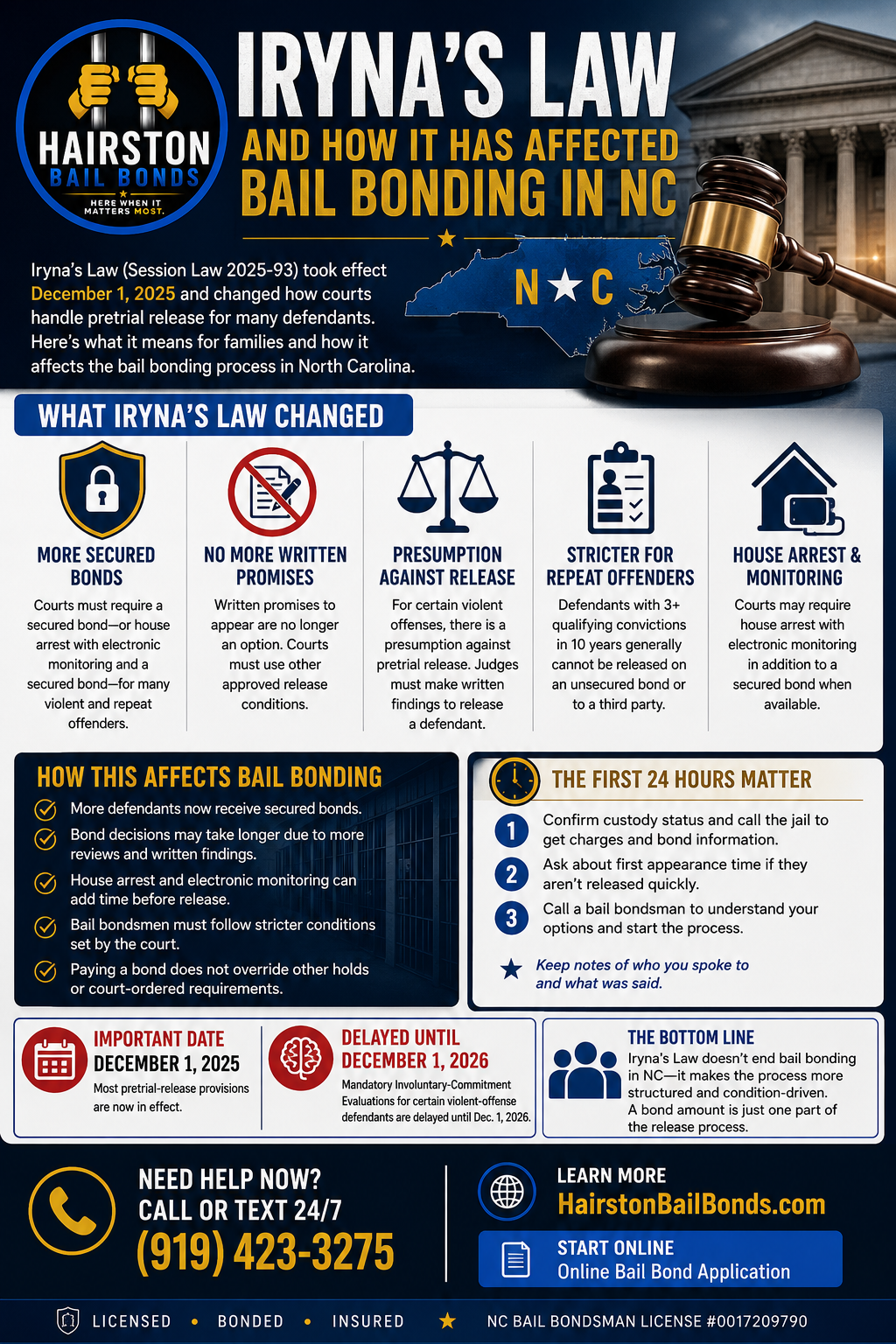
North Carolina’s bail and pretrial-release system changed significantly when lawmakers enacted Iryna’s Law, formally known as Session Law 2025-93, House Bill 307.
The law was passed following the death of 23-year-old Iryna Zarutska, who was fatally attacked on a Charlotte light-rail train in August 2025. The case led to intense public scrutiny of North Carolina’s pretrial-release system, particularly the handling of defendants with violent criminal histories or serious mental-health concerns.
Many of the law’s major pretrial-release provisions took effect on December 1, 2025. The changes affect magistrates, judges, law-enforcement officers, defendants, families, attorneys, detention centers, and licensed North Carolina bail bondsmen.
This article explains what Iryna’s Law changed and what those changes mean for the bail-bond process across North Carolina.
What Is Iryna’s Law?
Iryna’s Law is a broad North Carolina criminal-justice law that changed several areas of state law, including:
- Pretrial-release conditions
- Bail decisions for violent and repeat defendants
- Mental-health evaluations in certain criminal cases
- Required written findings by judicial officials
- Magistrate discipline
- Felony sentencing factors
- Death-penalty procedures
For families trying to get someone out of jail, the most important part of the law is its impact on pretrial release and secured bonds.
The law creates stricter rules for people charged with designated violent offenses and for defendants with significant criminal histories. It also requires law enforcement to give the judicial official relevant information about behavior suggesting that a defendant may be dangerous to themselves or others.
What Counts as a Violent Offense Under Iryna’s Law?
Iryna’s Law created a statutory category of “violent offenses” for purposes of pretrial release.
Whether a particular charge falls within that definition depends on the offense listed in North Carolina law. When a defendant is charged with a qualifying violent offense, the normal assumption that some form of release will be available becomes more restricted.
The law creates a rebuttable presumption against pretrial release for defendants charged with violent offenses. In plain language, that means the court begins with the position that ordinary release conditions may not be enough to ensure public safety or the defendant’s appearance in court.
That presumption can be overcome, but the judicial official must consider the defendant’s history and circumstances and make written findings supporting the release decision.
Secured Bonds Are Now Required in More Cases
One of the most important effects of Iryna’s Law is the increased use of secured bonds.
For a defendant charged with a first violent offense, the judicial official must generally impose either:
- A secured bond; or
- House arrest with electronic monitoring together with a secured bond.
For certain defendants accused of a second or subsequent violent offense, particularly where there is a prior violent conviction or the defendant was already on pretrial release for another violent offense, house arrest with electronic monitoring and a secured bond may be required when house arrest is available.
This matters because an unsecured bond, written promise, or simple release order may no longer be legally available in circumstances where those options may previously have been considered.
Written Promises to Appear Were Removed as a Release Option
Iryna’s Law removed the written promise to appear from North Carolina’s statutory pretrial-release options.
A written promise allowed some defendants to be released after signing an agreement that they would appear in court. No money or secured bond was necessarily required.
Following the new law, courts must use other legally authorized release conditions. Depending on the defendant and the charge, those conditions may include an unsecured bond, custody release, secured bond, electronic monitoring, house arrest, or detention.
For defendants covered by the law’s violent-offense or repeat-offender provisions, the available options are more limited.
Repeat Defendants Face Additional Restrictions
Iryna’s Law also affects defendants with substantial criminal records.
When a defendant has been convicted of at least three qualifying offenses in separate court sessions during the previous 10 years, the judicial official may not release that person on an unsecured bond or into the custody of another person.
In those cases, release must generally involve either:
- A secured bond; or
- House arrest with electronic monitoring.
The judicial official must also make written findings explaining why the selected release conditions are appropriate.
This means a person arrested on a charge that might not appear extremely serious by itself could still face stricter bond conditions because of their prior record.
How Has Iryna’s Law Affected Bail Bonding in North Carolina?
Iryna’s Law did not eliminate private bail bonding in North Carolina. In many cases, it has made licensed bail bondsmen even more relevant because secured bonds are now mandatory in additional situations.
However, the process has become more complicated.
More Defendants May Receive Secured Bonds
Because violent and repeat defendants face stricter release requirements, more defendants may receive secured bonds rather than unsecured release.
A secured bond usually requires one of the following:
- Payment of the full bond amount to the court
- A property bond, where permitted
- A surety bond posted through a licensed bail bondsman
Families who cannot afford to deposit the entire bond amount may contact a licensed bondsman to determine whether they qualify for a surety bond.
Bond Decisions May Take Longer
Before a bail bondsman can post a bond, a magistrate or judge must first establish valid conditions of release.
Under Iryna’s Law, judicial officials may need to:
- Review a defendant’s criminal history
- Determine whether the charge qualifies as a violent offense
- Consider prior pending charges
- Review law-enforcement observations
- Determine whether house arrest is required or available
- Make written findings supporting release
- Address possible mental-health concerns
This additional review can make some bond decisions slower than families expect.
A bondsman cannot override the court, set the bond amount, remove electronic monitoring, or post a bond before the release order is legally complete.
Some Defendants May Be Held Without Immediate Release
The law creates a presumption against release in certain violent-offense cases. That does not automatically mean every person charged with a violent offense will be held without bond, but it does mean release may require a more detailed judicial determination.
A family may call a bondsman ready to pay, only to learn that:
- A judge must review the case
- House arrest must be arranged
- The secured bond has not been finalized
- Additional written findings are required
- The defendant is not presently eligible for release
In those situations, the issue is not the willingness of the bondsman to post the bond. The legal conditions have not yet been satisfied.
House Arrest Can Affect When a Bond Is Posted
In some violent-offense cases, the court may require house arrest with electronic monitoring in addition to a secured bond.
That can create practical delays if monitoring must be approved, installed, or coordinated before the jail will release the defendant.
The General Assembly’s nonpartisan analysis states that judicial districts without house-arrest services were directed to enter agreements with vendors to provide the service.
For bail bondsmen, this means posting the financial bond may be only one part of the release process. Electronic-monitoring requirements may also need to be completed.
Bondsmen Must Pay Closer Attention to Release Orders
Under the new rules, the exact wording of the release order matters more than ever.
A North Carolina bail bondsman must confirm:
- The secured bond amount
- Whether multiple charges have separate bonds
- Whether house arrest is required
- Whether electronic monitoring must begin before release
- Whether the court has imposed additional restrictions
- Whether a judge, rather than a magistrate, must authorize release
- Whether the defendant is being held for another county, state, or federal agency
Simply knowing the dollar amount is no longer enough in many cases.
Mental-Health Evaluations and Pretrial Release
Iryna’s Law also created a procedure involving involuntary-commitment evaluations for certain defendants.
The law applies when a defendant is charged with a violent offense and court records indicate a recent involuntary commitment, or when a judicial official has reasonable grounds to believe that a defendant may be dangerous to themselves or others.
However, the effective date for this specific mandatory involuntary-commitment procedure was delayed until December 1, 2026.
When that provision becomes effective, some defendants may have to undergo an initial mental-health examination before the custody and release process can be completed.
That could create additional delays even when a financial bond has been set.
Families should understand that paying a bondsman does not cancel a medical or mental-health hold. A surety bond addresses the financial condition of release. It does not override other lawful custody orders.
What Iryna’s Law Means for Families
The new law makes it more important for families to obtain complete and accurate information before beginning the bail process.
Before contacting a bondsman, try to obtain:
- The defendant’s full legal name
- Date of birth
- County of arrest
- Jail or detention-center location
- Charges
- Bond amount
- Whether the bond is secured
- Whether a judge must set or review the bond
- Whether electronic monitoring or house arrest is required
- Whether the defendant has holds from another jurisdiction
Do not assume that a person can be released immediately because a bond amount appears online. The court may have added conditions that must be completed before release.
What a Bail Bondsman Can and Cannot Do
A licensed North Carolina bail bondsman can:
- Explain the surety-bond process
- Review the bond information
- Determine whether a cosigner or collateral is required
- Prepare the necessary bond paperwork
- Post an eligible secured bond
- Explain the defendant’s responsibilities
- Remind defendants about court obligations
- Help families understand release logistics
A bail bondsman cannot:
- Set or reduce the bond
- Change a judge’s release conditions
- provide legal representation
- Remove house arrest or electronic monitoring
- Release a defendant with a court or agency hold
- Guarantee an exact jail-release time
The detention center controls release processing after all legal conditions have been met.
Does Iryna’s Law Make Bail More Expensive?
Iryna’s Law does not create a new statewide bail-bond premium rate.
The financial impact comes primarily from the likelihood that certain defendants will receive secured bonds or additional release conditions instead of unsecured release.
Costs may also be affected by:
- Electronic monitoring
- House-arrest services
- Required down payments
- Collateral requirements
- Multiple simultaneous bonds
- Higher bond amounts based on criminal history or public-safety concerns
Every case is different. Families should request a clear explanation of the premium, payment terms, collateral, and cosigner responsibilities before signing a bail-bond agreement.
Does Iryna’s Law Apply in Every North Carolina County?
The statewide statutory changes apply throughout North Carolina.
However, each judicial district may maintain local pretrial-release policies implementing the law. The North Carolina Judicial Branch has published local administrative orders incorporating Iryna’s Law into district release policies.
Because procedures and available house-arrest programs may vary, the practical release process can differ from one county to another.
That is one reason working with a bondsman familiar with North Carolina county jails and court procedures can be valuable.
The Bottom Line
Iryna’s Law has made North Carolina’s pretrial-release system stricter for defendants charged with violent offenses and for people with significant criminal histories.
The law has:
- Expanded the circumstances requiring secured bonds
- Created a presumption against release in certain violent cases
- Restricted unsecured release for qualifying repeat defendants
- Removed written promises to appear as a release option
- Required more detailed written findings by magistrates and judges
- Increased the possible use of house arrest and electronic monitoring
- Added future mental-health evaluation procedures for certain defendants
For North Carolina bail bondsmen, the law has not ended surety bonding. Instead, it has increased the importance of verifying the full release order and understanding every condition attached to the bond.
For families, the most important lesson is this: a bond amount is only one part of the release process. The defendant must satisfy every condition ordered by the court before the jail can complete the release.
Need Help With a North Carolina Bail Bond?
Hairston Bail Bonds provides professional bail-bond assistance across Central North Carolina. We help families understand the bond, complete the paperwork, and move through the process as quickly as the court and detention center allow.
Call or text (919) 423-3275 for 24/7 assistance, or complete our online bail-bond application to get started.
This article is for general informational purposes only and is not legal advice. Pretrial-release conditions depend on the specific charges, criminal history, court orders, and county procedures involved in each case.