10 Things You Didn’t Know About Getting Out of Jail Fast in Alamance County, NC

If you or a loved one gets arrested in Alamance County, time is everything. But navigating the bail process can feel like walking through a maze. Don’t worry—we’ve got you covered! Here are 10 surprising facts about getting out of jail fast that you need to know.


1. You Don’t Have to Wait Until Morning

Think you can only bail someone out during business hours? Not true! In Alamance County, bail bond agents (like us!) work around the clock to help get your loved ones out of jail—even at 3 a.m.


2. Small Charges Can Have Big Bail Amounts

Even minor offenses like unpaid traffic tickets can lead to hefty bail amounts. It’s not about the crime; it’s about ensuring you show up for court.


3. Payment Plans Are an Option

No need to stress if you don’t have all the cash up front. Many bail bondsmen, including Hairston Bail Bonds, offer flexible payment plans to ease the burden.


4. Collateral Isn’t Always Necessary

People often think they’ll have to put up their car or house to secure bail, but that’s not always the case. Ask us about no-collateral bail options.


5. Knowing the Jail’s Schedule is Key

Each jail has its own processes and schedules for processing bail. In Alamance County, releases may take a few hours, depending on the time of day and jail activity.


6. Being Prepared Speeds Up the Process

Have the arrested person’s full name, booking number, and location ready when you call your bail bondsman. This simple step can save valuable time.


7. You Can Post Bail for Out-of-State Arrests

Got a friend or family member locked up in another state? You can still help from Alamance County! Hairston Bail Bonds can coordinate with other agents to get them released.


8. Weekends and Holidays Won’t Stop Us

Courts may close, but that doesn’t mean the bail process stops. Our agents are here 24/7—even during holidays and weekends—to get you through.


9. Mistakes Can Delay Release

Filing the wrong paperwork or giving incorrect information to the court can slow things down. That’s why working with an experienced bail bond agent is critical.


10. Bail Isn’t a “Get Out of Jail Free” Card

While bail gets you out of jail, it comes with strings attached. Missing your court date or violating terms can lead to re-arrest.


Why Hairston Bail Bonds?

When every second counts, trust the experts who know Alamance County inside and out. Hairston Bail Bonds is available 24/7 to make the process as smooth as possible.

📞 Call Us Anytime: (919) 423-3275
💻 Visit Our Office in Graham, NC

How Bail Bonds Work in North Carolina?

North Carolina Bail Bond Guide

How Bail Bonds Work in North Carolina

If someone you care about has been arrested in North Carolina, this guide explains the bail bond process, what a cosigner does, how payment works, and how Hairston Bail Bonds can help you start quickly online.

  • North Carolina bail bond process explained
  • Bond amount vs bail bond premium
  • Cosigner responsibilities
  • Online applications available
  • Remote e-signatures available
  • Zelle, Apple Pay & Google Pay options

What Is a Bail Bond?

A bail bond is a way to help someone get released from jail while their case is pending in court. Instead of paying the full bond amount directly to the court or jail, a bail bondsman posts a bond on the defendant’s behalf after the required paperwork and premium are completed.

In simple terms, the bond is a promise that the defendant will appear in court. The bail bondsman takes on financial risk, and the cosigner agrees to help make sure the defendant follows the court’s requirements.

Plain English version: A bail bond helps get someone released from jail, but it also creates responsibilities. The defendant must show up for court, and the cosigner may be financially responsible if they do not. Because naturally, the legal system decided stress needed fine print.

Key Terms to Know

  • Defendant: the person who was arrested
  • Bond amount: the amount set by the court or magistrate
  • Premium: the fee paid to the bail bondsman
  • Cosigner: the person signing responsibility for the bond
  • Collateral: property or value that may be required for higher-risk bonds
  • Court date: the date the defendant must appear

The North Carolina Bail Bond Process Step by Step

Every county can move a little differently, but most North Carolina bail situations follow this general path.

Arrest and Booking

After an arrest, the defendant is processed by law enforcement. Booking may include identification, fingerprints, photos, paperwork, and jail intake procedures.

Bond Is Set

A magistrate or court official reviews the situation and decides whether the defendant can be released and what bond conditions apply.

You Contact a Bail Bondsman

Once bond information is available, call Hairston Bail Bonds. We explain the premium, paperwork, payment options, and cosigner responsibilities.

Application and Paperwork

The cosigner completes the bail bond application and required documents. Online applications and remote e-signatures may be available.

Payment Is Arranged

Payment options may include Zelle, Apple Pay, Google Pay, card, cash, or other approved methods depending on the bond.

The Bond Is Posted

After requirements are complete, the bond process moves forward. The jail then handles release according to its internal procedures.

How Much Does a Bail Bond Cost in North Carolina?

The cost of a bail bond is usually called the bail bond premium. The premium is not the same thing as the full bond amount. The bond amount is the total amount set by the court. The premium is the fee paid for the bail bond service.

The exact amount due can depend on the bond amount, charge type, risk, cosigner strength, payment arrangement, and whether collateral is required.

For some qualified clients, flexible payment options may be available. Payment plans are not automatic and depend on approval. Annoying? Sure. Important? Absolutely.

What Can Affect the Amount Due?

  • Total bond amount
  • Type of charge
  • Defendant’s court history
  • Cosigner qualifications
  • Payment method
  • Collateral requirements
  • Risk level of the bond

Cosigner Responsibilities

The cosigner is the person who signs for the defendant’s bond. This is serious. You are not just “helping with paperwork.” You may be financially responsible if the defendant fails to appear in court or violates bond conditions.

  • Provide accurate information
  • Help ensure the defendant appears in court
  • Stay in contact with the bondsman
  • Notify the bondsman of address or phone changes
  • Understand financial responsibility before signing

What Does a Cosigner Do?

A cosigner helps secure the bail bond and agrees to take responsibility for the defendant following the court’s rules. The cosigner may need to provide identification, contact information, employment details, references, and payment information.

Before signing, make sure you understand what you are agreeing to. If the defendant misses court, there may be serious consequences, including bond forfeiture, re-arrest, and possible financial responsibility for the cosigner.

Important: Do not sign for someone unless you understand the responsibility and trust that they will go to court.

How Long Does It Take to Get Released From Jail?

Release time depends on the county, jail workload, booking status, bond type, staffing, paperwork, payment completion, holds, and the time of day. Some releases may happen within a few hours after bond is accepted. Others can take longer.

The fastest way to avoid preventable delays is to call as soon as bond information is available, complete the application accurately, sign documents quickly, and use an approved payment method.

Common Causes of Delay

  • Bond has not been set yet
  • Booking is not complete
  • Wrong name or date of birth
  • Incomplete application
  • Cosigner information missing
  • Payment not completed
  • Other holds or charges

Can Bail Bonds Be Done Online in North Carolina?

In many cases, the process can begin remotely. That matters when family members live out of town, cannot leave work, or need to move quickly from their phone.

Online Application

Start the process by completing the online bail bond application with the defendant and cosigner information.

Remote E-Signatures

Required documents may be signed electronically when remote signing is available and approved for the bond.

Mobile Payments

Approved payment methods may include Zelle, Apple Pay, Google Pay, debit or credit card, cash, or other accepted options.

Common Mistakes to Avoid

  • Waiting too long to call after bond is set
  • Providing incomplete defendant information
  • Signing without understanding cosigner responsibility
  • Missing court dates
  • Ignoring calls from the bondsman
  • Changing address or phone number without notice
  • Assuming release time is instant

What Happens After Release?

After release, the defendant must follow all court requirements and appear at every scheduled court date. The cosigner should stay aware of court dates and keep contact information updated.

If the defendant misses court, the court may issue an order for arrest, the bond may be forfeited, and the cosigner may face financial responsibility. This is why communication matters after release, not just before release.

North Carolina Counties We Help With

Hairston Bail Bonds helps families across multiple North Carolina counties with bail bond questions, jail release support, online applications, and remote paperwork options.

Need Help Understanding a Bond Right Now?

Call Hairston Bail Bonds for clear help with bond amounts, cosigner questions, online applications, remote signing, payment options, and jail release support.

North Carolina Bail Bonds FAQ

Fast answers to common questions about how bail bonds work in North Carolina.

What is a bail bond in North Carolina?
A bail bond is a way to help someone get released from jail while their case is pending. A licensed bondsman posts bond after the required paperwork and premium are completed.
How much does a bail bond cost?
The cost depends on the bond amount, charge type, risk, cosigner qualifications, payment arrangement, and whether collateral is needed.
Can I start the bail bond process online?
Yes. Hairston Bail Bonds offers an online application so you can start the process from your phone, tablet, or computer.
Can paperwork be signed remotely?
Remote e-signatures may be available depending on the bond, cosigner information, paperwork requirements, and approval.
What payment methods may be accepted?
Approved payment options may include Zelle, Apple Pay, Google Pay, debit or credit card, cash, and other accepted methods depending on the bond.
What does a cosigner do?
A cosigner signs responsibility for the bond and helps ensure the defendant appears in court and follows bond conditions. The cosigner may be financially responsible if the defendant misses court.
How long does jail release take after bond is posted?
Release time varies by county, jail workload, booking status, staffing, paperwork, bond type, holds, and time of day.
What happens if the defendant misses court?
Missing court can result in a bond forfeiture, an order for arrest, and possible financial responsibility for the cosigner. Contact the bondsman immediately if there is a court issue.
Do you offer payment plans?
Flexible payment options may be available for qualified clients. Approval depends on the bond amount, risk, cosigner strength, and case details.
Can out-of-town family members help with bail?
Yes. Online applications, remote e-signatures, and mobile payments may allow family members outside the county to help with the bond process.
Important: This page is general information about bail bonds in North Carolina and is not legal advice. Bail information, remote processing, payment plans, and accepted payment methods may depend on the bond amount, risk, cosigner qualifications, court order, jail processing, and company approval.

Call Hairston Bail Bonds for Help With the NC Bail Bond Process

If someone you care about has been arrested, you do not have to figure out the system alone. Call Hairston Bail Bonds and get clear guidance from a licensed North Carolina bail bondsman.

We help with bond information, online applications, remote paperwork, payment options, cosigner questions, jail release support, and county-specific bail bond needs.

Iryna’s Law in North Carolina: How the New Bail Rules Affect Defendants, Families, and Bail Bondsmen

Iryna’s Law in North Carolina: How the New Bail Rules Affect Defendants, Families, and Bail Bondsmen

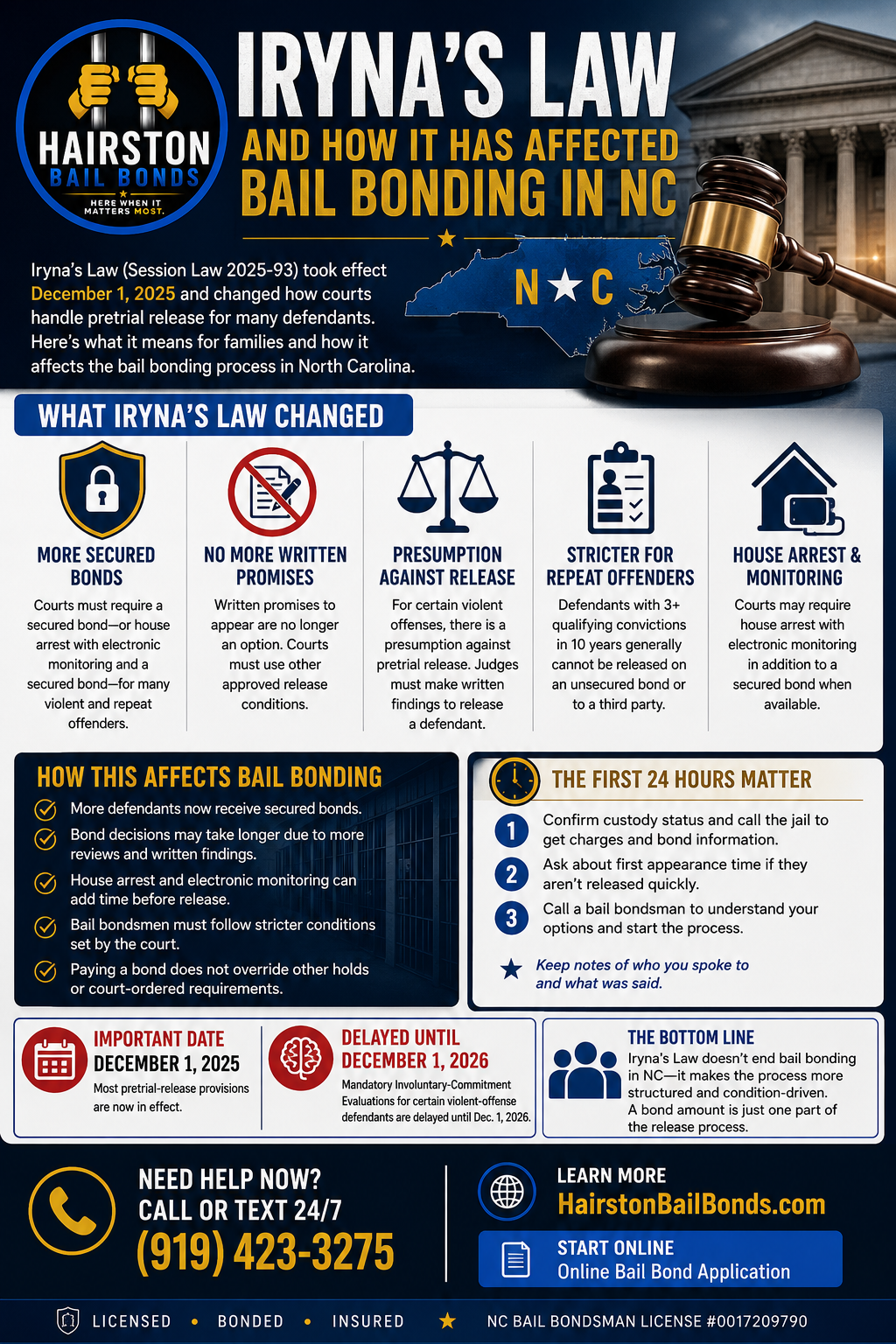
North Carolina’s bail and pretrial-release system changed significantly when lawmakers enacted Iryna’s Law, formally known as Session Law 2025-93, House Bill 307.

The law was passed following the death of 23-year-old Iryna Zarutska, who was fatally attacked on a Charlotte light-rail train in August 2025. The case led to intense public scrutiny of North Carolina’s pretrial-release system, particularly the handling of defendants with violent criminal histories or serious mental-health concerns.

Many of the law’s major pretrial-release provisions took effect on December 1, 2025. The changes affect magistrates, judges, law-enforcement officers, defendants, families, attorneys, detention centers, and licensed North Carolina bail bondsmen.

This article explains what Iryna’s Law changed and what those changes mean for the bail-bond process across North Carolina.

What Is Iryna’s Law?

Iryna’s Law is a broad North Carolina criminal-justice law that changed several areas of state law, including:

  • Pretrial-release conditions
  • Bail decisions for violent and repeat defendants
  • Mental-health evaluations in certain criminal cases
  • Required written findings by judicial officials
  • Magistrate discipline
  • Felony sentencing factors
  • Death-penalty procedures

For families trying to get someone out of jail, the most important part of the law is its impact on pretrial release and secured bonds.

The law creates stricter rules for people charged with designated violent offenses and for defendants with significant criminal histories. It also requires law enforcement to give the judicial official relevant information about behavior suggesting that a defendant may be dangerous to themselves or others.

What Counts as a Violent Offense Under Iryna’s Law?

Iryna’s Law created a statutory category of “violent offenses” for purposes of pretrial release.

Whether a particular charge falls within that definition depends on the offense listed in North Carolina law. When a defendant is charged with a qualifying violent offense, the normal assumption that some form of release will be available becomes more restricted.

The law creates a rebuttable presumption against pretrial release for defendants charged with violent offenses. In plain language, that means the court begins with the position that ordinary release conditions may not be enough to ensure public safety or the defendant’s appearance in court.

That presumption can be overcome, but the judicial official must consider the defendant’s history and circumstances and make written findings supporting the release decision.

Secured Bonds Are Now Required in More Cases

One of the most important effects of Iryna’s Law is the increased use of secured bonds.

For a defendant charged with a first violent offense, the judicial official must generally impose either:

  1. A secured bond; or
  2. House arrest with electronic monitoring together with a secured bond.

For certain defendants accused of a second or subsequent violent offense, particularly where there is a prior violent conviction or the defendant was already on pretrial release for another violent offense, house arrest with electronic monitoring and a secured bond may be required when house arrest is available.

This matters because an unsecured bond, written promise, or simple release order may no longer be legally available in circumstances where those options may previously have been considered.

Written Promises to Appear Were Removed as a Release Option

Iryna’s Law removed the written promise to appear from North Carolina’s statutory pretrial-release options.

A written promise allowed some defendants to be released after signing an agreement that they would appear in court. No money or secured bond was necessarily required.

Following the new law, courts must use other legally authorized release conditions. Depending on the defendant and the charge, those conditions may include an unsecured bond, custody release, secured bond, electronic monitoring, house arrest, or detention.

For defendants covered by the law’s violent-offense or repeat-offender provisions, the available options are more limited.

Repeat Defendants Face Additional Restrictions

Iryna’s Law also affects defendants with substantial criminal records.

When a defendant has been convicted of at least three qualifying offenses in separate court sessions during the previous 10 years, the judicial official may not release that person on an unsecured bond or into the custody of another person.

In those cases, release must generally involve either:

  • A secured bond; or
  • House arrest with electronic monitoring.

The judicial official must also make written findings explaining why the selected release conditions are appropriate.

This means a person arrested on a charge that might not appear extremely serious by itself could still face stricter bond conditions because of their prior record.

How Has Iryna’s Law Affected Bail Bonding in North Carolina?

Iryna’s Law did not eliminate private bail bonding in North Carolina. In many cases, it has made licensed bail bondsmen even more relevant because secured bonds are now mandatory in additional situations.

However, the process has become more complicated.

More Defendants May Receive Secured Bonds

Because violent and repeat defendants face stricter release requirements, more defendants may receive secured bonds rather than unsecured release.

A secured bond usually requires one of the following:

  • Payment of the full bond amount to the court
  • A property bond, where permitted
  • A surety bond posted through a licensed bail bondsman

Families who cannot afford to deposit the entire bond amount may contact a licensed bondsman to determine whether they qualify for a surety bond.

Bond Decisions May Take Longer

Before a bail bondsman can post a bond, a magistrate or judge must first establish valid conditions of release.

Under Iryna’s Law, judicial officials may need to:

  • Review a defendant’s criminal history
  • Determine whether the charge qualifies as a violent offense
  • Consider prior pending charges
  • Review law-enforcement observations
  • Determine whether house arrest is required or available
  • Make written findings supporting release
  • Address possible mental-health concerns

This additional review can make some bond decisions slower than families expect.

A bondsman cannot override the court, set the bond amount, remove electronic monitoring, or post a bond before the release order is legally complete.

Some Defendants May Be Held Without Immediate Release

The law creates a presumption against release in certain violent-offense cases. That does not automatically mean every person charged with a violent offense will be held without bond, but it does mean release may require a more detailed judicial determination.

A family may call a bondsman ready to pay, only to learn that:

  • A judge must review the case
  • House arrest must be arranged
  • The secured bond has not been finalized
  • Additional written findings are required
  • The defendant is not presently eligible for release

In those situations, the issue is not the willingness of the bondsman to post the bond. The legal conditions have not yet been satisfied.

House Arrest Can Affect When a Bond Is Posted

In some violent-offense cases, the court may require house arrest with electronic monitoring in addition to a secured bond.

That can create practical delays if monitoring must be approved, installed, or coordinated before the jail will release the defendant.

The General Assembly’s nonpartisan analysis states that judicial districts without house-arrest services were directed to enter agreements with vendors to provide the service.

For bail bondsmen, this means posting the financial bond may be only one part of the release process. Electronic-monitoring requirements may also need to be completed.

Bondsmen Must Pay Closer Attention to Release Orders

Under the new rules, the exact wording of the release order matters more than ever.

A North Carolina bail bondsman must confirm:

  • The secured bond amount
  • Whether multiple charges have separate bonds
  • Whether house arrest is required
  • Whether electronic monitoring must begin before release
  • Whether the court has imposed additional restrictions
  • Whether a judge, rather than a magistrate, must authorize release
  • Whether the defendant is being held for another county, state, or federal agency

Simply knowing the dollar amount is no longer enough in many cases.

Mental-Health Evaluations and Pretrial Release

Iryna’s Law also created a procedure involving involuntary-commitment evaluations for certain defendants.

The law applies when a defendant is charged with a violent offense and court records indicate a recent involuntary commitment, or when a judicial official has reasonable grounds to believe that a defendant may be dangerous to themselves or others.

However, the effective date for this specific mandatory involuntary-commitment procedure was delayed until December 1, 2026.

When that provision becomes effective, some defendants may have to undergo an initial mental-health examination before the custody and release process can be completed.

That could create additional delays even when a financial bond has been set.

Families should understand that paying a bondsman does not cancel a medical or mental-health hold. A surety bond addresses the financial condition of release. It does not override other lawful custody orders.

What Iryna’s Law Means for Families

The new law makes it more important for families to obtain complete and accurate information before beginning the bail process.

Before contacting a bondsman, try to obtain:

  • The defendant’s full legal name
  • Date of birth
  • County of arrest
  • Jail or detention-center location
  • Charges
  • Bond amount
  • Whether the bond is secured
  • Whether a judge must set or review the bond
  • Whether electronic monitoring or house arrest is required
  • Whether the defendant has holds from another jurisdiction

Do not assume that a person can be released immediately because a bond amount appears online. The court may have added conditions that must be completed before release.

What a Bail Bondsman Can and Cannot Do

A licensed North Carolina bail bondsman can:

  • Explain the surety-bond process
  • Review the bond information
  • Determine whether a cosigner or collateral is required
  • Prepare the necessary bond paperwork
  • Post an eligible secured bond
  • Explain the defendant’s responsibilities
  • Remind defendants about court obligations
  • Help families understand release logistics

A bail bondsman cannot:

  • Set or reduce the bond
  • Change a judge’s release conditions
  • provide legal representation
  • Remove house arrest or electronic monitoring
  • Release a defendant with a court or agency hold
  • Guarantee an exact jail-release time

The detention center controls release processing after all legal conditions have been met.

Does Iryna’s Law Make Bail More Expensive?

Iryna’s Law does not create a new statewide bail-bond premium rate.

The financial impact comes primarily from the likelihood that certain defendants will receive secured bonds or additional release conditions instead of unsecured release.

Costs may also be affected by:

  • Electronic monitoring
  • House-arrest services
  • Required down payments
  • Collateral requirements
  • Multiple simultaneous bonds
  • Higher bond amounts based on criminal history or public-safety concerns

Every case is different. Families should request a clear explanation of the premium, payment terms, collateral, and cosigner responsibilities before signing a bail-bond agreement.

Does Iryna’s Law Apply in Every North Carolina County?

The statewide statutory changes apply throughout North Carolina.

However, each judicial district may maintain local pretrial-release policies implementing the law. The North Carolina Judicial Branch has published local administrative orders incorporating Iryna’s Law into district release policies.

Because procedures and available house-arrest programs may vary, the practical release process can differ from one county to another.

That is one reason working with a bondsman familiar with North Carolina county jails and court procedures can be valuable.

The Bottom Line

Iryna’s Law has made North Carolina’s pretrial-release system stricter for defendants charged with violent offenses and for people with significant criminal histories.

The law has:

  • Expanded the circumstances requiring secured bonds
  • Created a presumption against release in certain violent cases
  • Restricted unsecured release for qualifying repeat defendants
  • Removed written promises to appear as a release option
  • Required more detailed written findings by magistrates and judges
  • Increased the possible use of house arrest and electronic monitoring
  • Added future mental-health evaluation procedures for certain defendants

For North Carolina bail bondsmen, the law has not ended surety bonding. Instead, it has increased the importance of verifying the full release order and understanding every condition attached to the bond.

For families, the most important lesson is this: a bond amount is only one part of the release process. The defendant must satisfy every condition ordered by the court before the jail can complete the release.

Need Help With a North Carolina Bail Bond?

Hairston Bail Bonds provides professional bail-bond assistance across Central North Carolina. We help families understand the bond, complete the paperwork, and move through the process as quickly as the court and detention center allow.

Call or text (919) 423-3275 for 24/7 assistance, or complete our online bail-bond application to get started.

This article is for general informational purposes only and is not legal advice. Pretrial-release conditions depend on the specific charges, criminal history, court orders, and county procedures involved in each case.
Get Out Fast: A No-Bull Guide to Bail Bonds in Alamance, Orange & Chatham Counties

Get Out Fast: A No-Bull Guide to Bail Bonds in Alamance, Orange & Chatham Counties

If someone you love is in jail, you don’t need a lecture — you need answers and action. Here’s exactly what to do to get them out fast.

Call now: (919) 423-3275 — we’re available and ready to help.

Why acting fast matters

Jails move at their own pace. The sooner you start the bail process, the sooner the paperwork is filed and the quicker your person is released. Small delays (missing info, wrong payment method, or not knowing where to meet) can add hours to the timeline — and when minutes matter, hours feel like forever.

3 simple steps to get out fast

  1. Call us or apply online. Tell us the defendant’s name, DOB, and where they’re being held. We’ll tell you the bond amount and next steps. Apply online if you prefer.
  2. Provide ID and payment or cosigner info. We accept cards, cash, and workable payment plans for qualified applicants.
  3. We post the bond and meet you at the jail if needed. Once paperwork and payment are confirmed we post bail and arrange the pickup — fast and discreet.

What to expect at the jail

Every county’s intake process varies, but generally: the county processes paperwork, confirms the bond has been posted, and then releases the person. We know local jails in Alamance County, Orange County, and Chatham County — that local knowledge shaves time off the process.

Payment, collateral & cosigners — what you need to know

  • Premiums: You pay the premium (percentage of the bond) or arrange a payment plan with us.
  • Collateral: If required, we’ll explain options (vehicle, property, or other acceptable collateral).
  • Cosigners: A qualified cosigner can speed things up. We’ll tell you who qualifies and what documents are needed.

We always explain costs up front — no surprises. If you’re worried about affordability, call and ask about our payment plans.

Do’s and don’ts — quick checklist

  • Do call us first. We’ll tell you what the jail needs and what to bring.
  • Do have a form of ID ready and proof of the defendant’s identity if possible.
  • Don’t hand over the wrong paperwork or miss signatures — that delays everything.
  • Don’t trust promises from strangers. Use a licensed bondsman you can reach quickly.

Why Hairston Bail Bonds?

We post bail fast, explain things without the legal fluff, and meet clients at the jail to make the release go smoother. We’re licensed in North Carolina and serve Alamance, Orange, Chatham — and nearby counties. We’re direct, respectful, and available when you need us.

Call now: (919) 423-3275 — or fill out our Online Application and we’ll call you right back.

Local jail & court links

Need specifics? Visit our local county pages for jail hours, directions, and county-specific tips:

Real clients — real results

Mark D. — “They met us at the jail and had my brother out within an hour. No drama, no judgement.”

Quick FAQ

How fast can you post bail?
Usually within an hour after paperwork and payment are confirmed — sometimes faster depending on county processing.
Do you meet at the jail?
Yes — we’ll meet you at the jail to finalize paperwork and speed up release.
Do you offer payment plans?
Yes. We offer payment plans for qualified clients — call for details.

How Bail Works in North Carolina (Step-by-Step Guide)

Step-by-step guide explaining how bail bonds work in North Carolina with Hairston Bail Bonds

How Bail Works in North Carolina (Step-by-Step Guide)

When a loved one gets arrested in North Carolina, the situation can feel overwhelming and confusing. Understanding how bail works can help you make smart, quick decisions and get them home faster. Here’s a step-by-step guide to how bail bonds work in North Carolina:


Step 1: Arrest and Booking

When someone is arrested, they’re taken to the local jail for booking. This involves:

  • Recording personal info and charges
  • Fingerprinting and mugshot
  • Placing the person in holding

Depending on the charge, they may be eligible for release shortly after — but in most cases, they’ll need to go before a magistrate.


Step 2: Bail Is Set by a Magistrate

The magistrate will look at:

  • The severity of the charge
  • The person’s criminal history
  • Flight risk or community safety concerns

The magistrate can either:

  • Deny bail (in rare cases)
  • Set a written promise to appear (no money)
  • Require a secured bond (cash or bond needed to be released)

Step 3: Choose How to Post Bail

There are 3 main ways to post bail in NC:

  1. Cash Bond – Pay the full amount to the jail (refunded after case ends, if all court dates are met).
  2. Property Bond – Use real estate as collateral (this takes longer and involves paperwork).
  3. Hire a Bail Bondsman – Pay a percentage (usually 10%-15%) to a licensed bail agent. The bondsman covers the rest.

👉 This is the fastest and most affordable way for most families to get someone out.


Step 4: Call a Bail Bondsman (Like Us!)

Once you know the bail amount, reach out to a local, licensed bail bondsman. Here’s what we need:

  • Defendant’s full name and date of birth
  • Jail or county where they’re being held
  • Bail amount (if known)
  • Your info as the co-signer

We’ll walk you through the paperwork and start the process ASAP.


Step 5: Bail Is Posted – Defendant Is Released

Once everything’s approved, we post the bond with the jail. Depending on how busy things are, release can take anywhere from 30 minutes to several hours.


Step 6: Defendant Must Attend All Court Dates

After release, it’s crucial the defendant:

  • Shows up for every court date
  • Follows all conditions of release
  • Stays in contact with you (the co-signer)

If they skip court (called a “failure to appear”), the full bond becomes due, and a warrant will be issued.


💡 Need Bail Help Now?

We’re available 24/7 to help you through the process — fast, respectful, and local. Whether it’s Alamance, Guilford, Chatham, or Caswell County, Hairston Bail Bonds has your back.

📞 Call us now or apply online:
👉 https://hairstonbailbonds.com


Tags: #NorthCarolinaBail #BailProcessNC #HairstonBailBonds #BailBondsmanNC #StepByStepGuide


Your Trusted Bail Bondsman: Fast, Reliable, and Professional Services When You Need Them Most

Your Trusted Bail Bondsman: Fast, Reliable, and Professional Services When You Need Them Most

When you or a loved one faces an unexpected arrest, the situation can be overwhelming and confusing. During such stressful times, you need a reliable, trustworthy bail bondsman who can guide you through the process with speed and professionalism. At Hairston Bail Bonds, we specialize in offering fast, discreet, and affordable bail bond services to help you regain your freedom quickly.

Here’s why Hairston Bail Bonds is the first choice for people seeking help with bail bonds:

1. Fast and Efficient Service

When an arrest happens, time is of the essence. At Hairston Bail Bonds, we understand the urgency of the situation. Our team works tirelessly to expedite the bail process, ensuring that you or your loved one is out as soon as possible. With our years of experience, we know exactly how to navigate the legal system and get you the best results quickly.

2. 24/7 Availability

Arrests don’t happen on a schedule, and we know that. That’s why we offer around-the-clock bail bond services, 7 days a week. Whether it’s late at night or on a holiday, Hairston Bail Bonds is here to help whenever you need us. We’re just a phone call away!

3. Affordable and Flexible Payment Plans

At Hairston Bail Bonds, we believe in offering fair pricing for our services. We understand that paying bail can be financially difficult, which is why we offer flexible payment plans that can accommodate your budget. Our goal is to help you through this challenging time without adding financial stress.

4. Confidential and Discreet Services

We know that privacy is a top priority when it comes to bail bonds. Our team guarantees that your situation will be handled with the utmost discretion. You can trust Hairston Bail Bonds to protect your personal information and ensure your case remains confidential throughout the process.

5. Experienced Bail Bondsmen Who Care

When you choose Hairston Bail Bonds, you’re not just getting a service—you’re getting a partner who genuinely cares. Our team of experienced bondsmen has years of expertise in handling all types of bail bonds. We will explain every step of the process to make sure you understand exactly what’s happening, and we’ll be there for you every step of the way.

6. We Work With You

Every case is unique, and we take a personalized approach to help ensure the best possible outcome for each client. At Hairston Bail Bonds, we’ll take the time to assess your specific situation and work closely with you to determine the best approach. We believe in clear, honest communication and will always be transparent about your options.

7. Serving the Local Community

As a locally-owned and operated bail bond company, Hairston Bail Bonds is deeply committed to serving our community. We take pride in being a trusted resource for individuals and families in need, and our reputation speaks for itself. We’ve helped countless clients get back on their feet, and we’re ready to help you too.

8. We Can Handle All Types of Bail Bonds

Whether it’s a misdemeanor or a felony, no case is too big or small for our experienced team. From traffic offenses to more serious charges, we specialize in providing bail bond services for all types of arrests. Our comprehensive knowledge of the legal system allows us to help with even the most complex cases.


Why Choose Hairston Bail Bonds?

  • Fast, reliable, and discreet service
  • 24/7 availability—always here when you need us
  • Affordable, flexible payment plans tailored to your needs
  • Professional and caring team of experienced bondsmen
  • Trusted by the local community with years of proven success

Get the Help You Need Today!

At Hairston Bail Bonds, we’re here to provide you with the support, knowledge, and assistance you need during one of life’s most stressful situations. Don’t face the legal process alone—let us help you secure your release and move forward with confidence.

If you or someone you know needs help with a bail bond, don’t hesitate to reach out to us. Call us today at [Insert Phone Number] or fill out our online contact form to get started. We’re available 24/7 to offer fast, professional bail bond services.

Hairston Bail Bonds—Your Freedom, Our Priority.

Understanding Payment Plans and Collateral for Bail Bonds in North Carolina

Understanding-Payment-Plans-and-Collateral-for-Bail-Bonds-in-North-Carolina

Understanding Payment Plans and Collateral for Bail Bonds in North Carolina

If you or someone you know is in need of a bail bond in North Carolina, navigating the financial aspects of securing a bond can be daunting. At Hairston Bail Bonds, we’re here to provide clarity on how payment plans and collateral work, making the process as smooth as possible.

Payment Plans for Bail Bonds

The cost of a bail bond is typically 10% of the total bail amount set by the court. However, coming up with this fee in full can be challenging for many families. That’s why we offer flexible payment plans to help ease the financial burden.

Here’s how our payment plans work:

  1. Assessment of Your Situation: When you contact us, we’ll assess your financial situation to determine the best payment plan for you. We take into account your income, expenses, and ability to make payments.
  2. Customizable Payment Options: We offer various payment options, including monthly installments or other arrangements tailored to your needs. Our goal is to find a plan that fits your budget while ensuring the bond is secured promptly.
  3. Transparent Terms: We believe in clear and straightforward communication. We’ll explain the terms of the payment plan, including the total amount you’ll pay and any additional fees.
  4. Flexible and Compassionate Service: Our team understands that every situation is unique. We’re committed to working with you to find a solution that helps you through this difficult time without unnecessary stress.

Types of Collateral for Bail Bonds

Collateral is an asset you pledge to secure the bail bond. It provides additional security for the bail bondsman, ensuring that the defendant will attend all required court appearances. Collateral is particularly useful if you cannot afford the bail bond fee in full.

Common types of collateral include:

  • Real Estate: Property such as homes or land can be used as collateral. This is often a preferred option due to its high value.
  • Vehicles: Cars, trucks, or motorcycles with clear titles can be used. Ensure that the vehicle is free of any loans or liens.
  • Jewelry: Valuable items like gold, diamonds, or other high-value jewelry can serve as effective collateral.
  • Cash: Liquid funds are straightforward and provide immediate security for the bail bond.
  • Personal Property: Items of significant value, such as electronics or artwork, can also be considered.

How to Determine the Best Collateral for Your Situation:

  1. Valuation: Assess the value of your collateral to ensure it meets the requirements of the bail bond. We can help with this process to ensure everything is in order.
  2. Documentation: Provide necessary documentation for the collateral, such as titles, appraisals, or proof of ownership.
  3. Collateral Agreement: Understand the terms of the collateral agreement. This will include details on how and when the collateral will be returned once the bail bond obligations are fulfilled.

Why Choose Hairston Bail Bonds?

At Hairston Bail Bonds, we are dedicated to providing exceptional service and support. We understand that securing a bail bond can be stressful, which is why we offer flexible payment plans and accept various forms of collateral to help you manage the costs effectively.

Our experienced team is here to guide you through every step of the process, from setting up a payment plan to securing the right collateral. We aim to make the bail process as seamless and stress-free as possible, ensuring you can focus on more important matters.

For more information on payment plans, collateral, or any other aspects of the bail bond process, don’t hesitate to reach out to us. We’re here to help you navigate this challenging time with ease.

Understanding Bail Bond Laws in North Carolina

bail bonds nc HAIRSTON BAIL BONDS-LOCATIONS

Navigating the legal system can be overwhelming, especially when it comes to understanding bail bond laws. In North Carolina, the regulations governing bail bonds are outlined in Article 71 of Chapter 58 of the North Carolina General Statutes. This guide will break down the key aspects of these laws to help you better understand your rights and responsibilities when dealing with bail bonds.

What is a Bail Bond?

A bail bond is a financial guarantee that a defendant will appear in court as required. When someone is arrested, the court may set a bail amount. If the defendant cannot afford to pay the full bail, they can seek the assistance of a bail bondsman. The bondsman will post the bail in exchange for a fee, typically a percentage of the total bail amount.

Key Provisions of North Carolina Bail Bond Laws

  1. Licensing and Regulation of Bail Bondsmen
  • Bail bondsmen in North Carolina must be licensed to operate legally. The licensing process includes background checks, education requirements, and passing a state exam.
  • The North Carolina Department of Insurance regulates bondsmen, ensuring they adhere to strict ethical and professional standards.
  1. Types of Bail Bonds
  • Surety Bonds: The most common type of bail bond, where a bail bondsman pays the bail on behalf of the defendant.
  • Cash Bonds: The defendant or a family member pays the full bail amount in cash.
  • Property Bonds: The defendant or a third party uses real property as collateral for the bail amount.
  1. Bail Bond Fees
  • The fee for a bail bond in North Carolina is typically around 15% of the total bail amount. This fee is non-refundable and is the cost of using the bail bondsman’s services.
  • There are also provisions for premium financing, allowing defendants to pay the bail bond fee in installments under certain conditions.
  1. Obligations of Bail Bondsmen
  • Bail bondsmen must ensure that the defendant appears in court as required. If the defendant fails to appear, the bondsman is responsible for paying the full bail amount to the court.
  • Bondsmen have the authority to apprehend and surrender the defendant if they skip bail.
  1. Forfeiture and Remission
  • If a defendant fails to appear in court, the bail bond is forfeited, and the bondsman must pay the full bail amount.
  • However, if the defendant is later apprehended or appears in court voluntarily within a specified period, the bondsman may apply for remission of the forfeited bond.
  1. Prohibited Practices
  • North Carolina law prohibits certain practices by bail bondsmen, such as charging excessive fees, employing unlicensed individuals, or engaging in activities that could be considered a conflict of interest.

Rights of Defendants

Defendants in North Carolina have specific rights related to bail bonds, including:

  • The right to be informed of the bail amount and the conditions of their release.
  • The right to seek the services of a licensed bail bondsman.
  • The right to a fair and transparent process when obtaining a bail bond.

Conclusion

Understanding the bail bond laws in North Carolina is crucial for anyone navigating the legal system. These laws ensure a fair and regulated process for all parties involved. Whether you are seeking the services of a bail bondsman or want to learn more about your rights and responsibilities, it’s essential to be informed about the regulations that govern bail bonds in the state.

For more detailed information, you can refer to Article 71 of Chapter 58 of the North Carolina General Statutes.

If you or a loved one needs assistance with bail bonds, contact Hairston Bail Bond Services in North Carolina for expert support and guidance. We provide fast, reliable, and compassionate bail bond services to help you through this challenging time.


Understanding Failure to Appear (FTA) Bonds in North Carolina

When someone is released on bail, they are legally obligated to attend all scheduled court appearances. Failing to do so can result in serious consequences, including the issuance of a Failure to Appear (FTA) warrant. To address this, FTA bonds come into play. This blog post will explore what FTA bonds are, how they work, and their significance in the North Carolina legal system.

What is a Failure to Appear (FTA) Bond?

A Failure to Appear (FTA) bond is a type of bail bond issued when a defendant fails to appear in court as required. When a defendant misses a court date, a judge can issue an FTA warrant for their arrest. To avoid remaining in custody, the defendant may need to secure an FTA bond, which acts as a financial guarantee to ensure future court appearances.

How Do FTA Bonds Work?

  1. Missed Court Appearance:
  • When a defendant misses a scheduled court date, the court may issue an FTA warrant. This warrant authorizes law enforcement to arrest the defendant.
  1. Contacting a Bail Bondsman:
  • Once the FTA warrant is issued, the defendant or their loved ones can contact a bail bondsman to arrange an FTA bond. The bondsman will assess the situation and determine the bond amount required.
  1. Posting the FTA Bond:
  • The bail bondsman posts the FTA bond on behalf of the defendant, securing their release from custody. This bond serves as a financial guarantee that the defendant will attend all future court dates.
  1. Court Appearances:
  • After being released on an FTA bond, the defendant must attend all rescheduled court appearances. Failure to do so can result in the forfeiture of the bond and re-arrest.

Importance of FTA Bonds

  • Ensuring Court Compliance:
  • FTA bonds incentivize defendants to comply with court requirements. By securing an FTA bond, defendants commit to attending all future court dates, reducing the likelihood of additional legal trouble.
  • Financial Consequences:
  • If a defendant fails to appear in court after securing an FTA bond, the bond amount is forfeited. This financial loss can be significant and serves as a deterrent against skipping court appearances.
  • Legal Repercussions:
  • Missing a court date without a valid reason can lead to additional charges and penalties. An FTA bond helps mitigate these risks by ensuring that the defendant returns to court as required.

How Hairston Bail Bonds Can Help

At Hairston Bail Bonds, we understand the stress and complications that come with an FTA warrant. Our experienced team is here to assist you in securing an FTA bond quickly and efficiently. We offer:

  • 24/7 Availability: Arrests and FTA warrants can happen at any time. Our team is available around the clock to provide immediate assistance.
  • Experienced Professionals: Our knowledgeable bail bondsmen have years of experience handling FTA bonds and other types of bail bonds in North Carolina.
  • Confidential and Compassionate Service: We handle all cases with the utmost confidentiality and compassion, ensuring a smooth and stress-free process.

Conclusion

Failure to appear in court can have serious consequences, but understanding FTA bonds can help mitigate these risks. By securing an FTA bond, defendants can ensure their release from custody and commit to attending all future court appearances. If you or a loved one is facing an FTA warrant, contact Hairston Bail Bonds for fast, reliable, and professional assistance.


Tags: Failure to Appear, FTA Bond, Bail Bonds, North Carolina, Legal Help, Court Appearance, Arrest Warrant, Bail Bondsman, Legal Advice, Court Compliance, 24/7 Availability